Mach-Zehnder Interferometers
ach-Zehnder interferometers (MZI) are one of the simplest two-path interferometers to implement on a chip. They consist of a splitter, two delay lines, and a combiner coupler. In their simplicity, they are the basis for many more complex components.
The PICAZZO MZI classes provide a parametric framework to define both very simple and very advanced MZIs. The couplers for the splitter and combiner can be supplied by the user, using MMIs, directional couplers, or just Y-Splitters. The arms can be simple delay lines, or contain separate components, such as ring resonators or electro-optic phase shifters.
The hierarchy of an MZI is illustrated below:
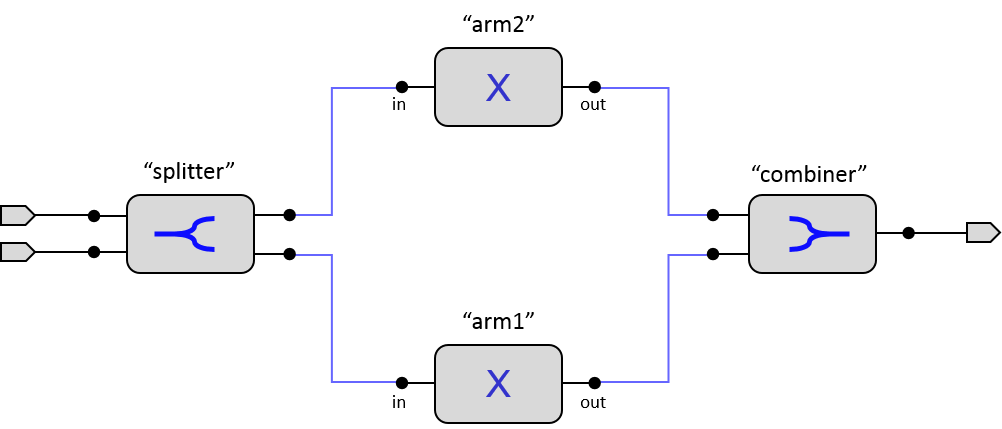
Because the splitter and combiner can be defined manually, the user specifies which of their ports connect to arm1 and arm2 using the splitter_port_names and combiner_port_names properties, respectively (the defaults follow the pattern in1, out1, …).
Likewise, the corresponding ports on the arms are specified in arm1_port_names and arm2_port_names.
Two basic MZI classes are provided: one with simple delay lines, and one where each arm is a container with a user-defined cell.
Generic MZI, taking a splitter, combiner and two _MziArm objects. |
|
A MZI with two simple waveguide arms. |
|
An MZI which contains another cell in one or both arms. |
The individual arms can also be defined manually.
A Mach-Zehnder arm with a given length: routing upward at right-angle |
|
A Mach-Zehnder arm which contains another cell and connects it to the splitter and combiner port |